New York City does not belong to the
United States.
Okay, technically, it does. Its citizens
vote in national elections, it has
congressmen in the House of
Representatives, it gets federal
funding and all that. Okay. But New
York transcends the idea of cityhood.
It doesn’t belong to any one country.
It belongs to the world.
It’s a magical place. Oz with big yellow
taxis. Walking the streets, you get a
feeling of being dwarfed by history.
Everything seems to be happening in
the sky. The buildings grow out of the
sidewalks like manmade redwoods,
reaching through the clouds to scratch
the heavens.
It is home to an incredibly diverse eight
million that live in its 400 + distinct
neighborhoods. It has a robust central
business district and is the heart of
global business, finance, and
communications. It has a massive
public transportation system, world-
class museums, concert houses, art
galleries, theatre – even the United
Nations.
Neighborhood names conjure images:
Harlem, Chinatown, Hell’s Kitchen, The
Bowery, Little Italy, Bed Sty, Greenwich
Village, SoHo, 5th Avenue, 42nd
Street, TriBeCa, Tin Pan Alley, Battery
Park. Give my regards to Broadway,
remember me to Herald Square. You
can be familiar with New York without
ever having set foot in it.
But did you know that in the 1840s
thousands of pigs roamed Wall Street
to consume garbage as an early
sanitation system? Or that German
immigrants flocked here by the
thousands in 1848 to escape a
revolution? Or that the Statue of
Liberty weighs 450,000 pounds?
Here are 10 more things you’re sure to
have heard of, but just how well do you
know them?
Boroughs. Manhattan is not New
York City, but you would be forgiven
for thinking it is because to most, the
two are synonymous. New York City is
actually divided into five boroughs:
Queens, Brooklyn, Staten Island, The
Bronx -- and Manhattan.
Landwise, Queens is the largest of the
five. It is heavily industrialized, and
home to LaGuardia and JFK airports,
Shea Stadium, and Calvary Cemetery,
the biggest in the US with over 2.5
million graves.
Brooklyn is the second largest in size
but largest in population. It is so big, in
fact, that were it a separate city it
would be the third largest in the US
after Los Angeles and Chicago. It has
a strong separate identity. Its Bedford
Stuyvesant neighborhood is the
largest black community in the United
States, and Borough Park , Crown
Heights, Williamsburgh all have large
populations of Orthodox Jews.
Staten Island is third largest and least
populous. Its claim to fame is the
Voorlezer’s House. Built in 1695, it is
the nation’s oldest surviving
elementary school building.
The Bronx is the only borough on the
American mainland. Its many
attractions include the world-famous
Bronx Zoo and the New York Botanical
Garden. But the heart and soul of The
Bronx is Yankee Stadium, home of the
New York Yankees baseball team.
The smallest yet most identifiable
borough is the island of Manhattan. If
New York is the crown of American
cities, then Manhattan is the glittering
jewel in that crown. It is oldest,
densest, and most built-up part of the
five boroughs, the center of New
York’s cultural and business life, and
address to some of the most glorious
architecture on the planet. Noteworthy
structures include the Chrysler
Building, City Hall, The Seagram
Building, Saint Patrick’s Cathedral, the
New York Public Library, and the
Empire State Building.
Times Square. The New York Times
newspaper office, after which the
world’s most famous square is named,
is no longer in Times Square. But the
name has stuck.
And although the newspaper has
moved, Times Square is still famous
for its strip of lights that flash up-to-the-
minute headlines and of course the up-
to-the-second stock prices on the now
famous Nasdaq ticker. It’s also home
to the world’s busiest McDonald’s.
At the intersection of Broadway, 42nd
St. and Seventh Avenue, Times
Square is a high traffic area, a
profusion of twisting neon and gigantic
illuminated electrical signs, home to 45
Broadway theaters that draw 11.6
million people annually and generate
tickets sales of more than US$588.5
million. There are 5,000 businesses in
the area, with 250,000 worker bees
engaged to run them. It is the heart of
the hospitality district, with 28 major
hotels, one-fifth of the city’s hotel
space.
Every year, close to a million people
gather in its streets on New Year’s Eve
to count off the seconds of the old
year and watch the big ball descend
from the flagpole at One Times
Square. Begun all the way back in
1907, the ball lowering ceremony is a
worldwide television event and for
many it has become a custom for
welcoming the new year.
The Subway. In 1900, construction
began on one of the city’s great
achievements. New York’s was not the
first subway in the world (London’s
was), or even in the US (Boston there),
but it was unique in the way it was
built. Using the “cut and cover”
method.
This is how it went. A ditch was dug, a
great big pipe was put in it, one big
enough to hold a couple of subway
trains, and then it was covered over
with dirt and a road or building was put
on top of that.
The subway immediately transformed
the city, as the areas that were once
considered far away and inaccessible
were now only a short train ride.
Sparsely developed neighborhoods
burgeoned seemingly overnight.
The subway goes all over the city,
except Staten Island. It is cheap,
reliable, and convenient, but with its
many train lines, service changes,
transfer stations, and complicated
connections, it can sometimes be
confusing, even to the native. If you
have a question, ask a subway clerk.
Some of them are about as unhelpful
as you could possibly imagine, giving
new meaning to the word “irascible,”
but if you speak quickly and loudly the
chances are good you will get the
information you want. You can find
this paradigm of pleasant sitting
behind bulletproof glass at any and all
stations.
Yankee Stadium. Take a subway to
The Bronx and get off at “The House
That Ruth Built,” nicknamed thus for its
greatest player, the legendary Babe
Ruth. This grandiose ballpark opened
in 1923, a year after Ruth was brought
over from the Boston Red Sox in one
of the worst sports trades of all time.
Back then, the stadium was massive,
and it’s odd shape was specifically
designed so their new star player
could hit more home runs. It was three
tiers tall, so big they used to call it
Skyscraper Ballpark.
The stadium was gutted in 1973 and
reopened in 1976, but it still retains its
old ballpark feel – and its majesty.
The Yankees have hosted 33 World
Series, winning 26 world titles.
One of the sporting world’s most
prestigious addresses, it has also
been home to many famous events.
On December 28, 1958, the Baltimore
Colts beat the New York Giants in what
is widely recognized as "the greatest
football game ever played." And in
boxing, Joe Louis clobbered
Germany's Max Schmeling on June 22,
1938, with a stunning and
controversial first-round knockout, and
Mohammad Ali beat Ken Norton here
on September 28, 1976.
Museum of Modern Art. Its
definition of modern art is interesting:
art that is of the modern period, that is,
the mid-19th Century to the present.
Its opening exhibition, “Cézanne,
Gauguin, Seurat, van Gogh,” held in
1929 in several rented rooms, grew
into a vast collection of paintings,
sculpture, prints, drawings, film,
photography, decorative arts and even
furniture.
In 1939 the museum moved into its
permanent headquarters, designed by
American architects Edward Durell
Stone and Philip L. Goodwin, at
11 West 53rd Street.
It is considered the greatest collection
of modern art in the world. Highlights
include Salvador Dali’s The
Persistence of Memory, Vincent Van
Gogh’s The Starry Night, Henri
Rousseau’s The Dream, Paul
Cezanne’s The Bather, and Pablo
Picasso’s Les Demoiselles d'Avignon,
just to name a few. It is best to check
out their website at www.moma.org to
find out what is currently in the
museum as some of the works are on
loan to other galleries.
The Empire State Building. This is
the tallest skyscraper in New York and,
at 1,250 feet, the tallest brick structure
in the world. It has a busy second
career as a lightening rod and is struck
up to 100 times per year.
Construction on this 102 story building
began in 1930 not long after the
bottom fell out of the stock market, and
by the time it opened in 1931, the
ensuing economic depression made
space was so difficult to rent that it was
monikered “The Empty State
Building.” The popularity of the
observation deck was the only thing
that kept the building from total
bankruptcy in those early days.
On clear days visitors to the 86th floor
observation deck can see the
surrounding countryside for distances
of up to 80 miles, looking into the
neighboring states of New Jersey,
Pennsylvania, Connecticut and
Massachusetts, as well as New York.
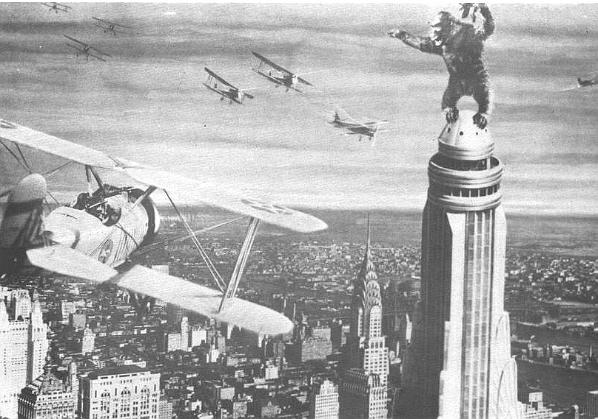
The building has strong ties to pop
culture and has been seen in many
films, but it is perhaps most famous as
where King Kong (above) made his
last stand, fighting off
bi-planes and clutching Faye Wray
before plummeting to his sad and
tragic death.
Theatre. In the 1930s and 40s,
theatre was an exciting part of
American culture. People from all over
the country came in droves to see the
best and brightest of Broadway. Some
of those plays, like Arthur Miller’s
Death of a Salesman and Tennessee
Williams’ A Streetcar Named Desire,
became hallmarks of world literature.
Sadly, Broadway is not what it was.
These days, Times Square is full of
puffed up, long running musicals, like
Disney’s The Lion King, and several
theaters from the city’s golden age
have been lost to the wrecking ball.
One of the best places to see a play is
not on Broadway, but in one of the
many Off-Broadway houses. Famous
film actors show up there from time to
time to keep their chops up. But even
off-Broadway, get ready for a kick in
the wallet. The average seat costs
US$50.
Wall Street. In 1653, a threat
emerged to the Dutch tradesmen:
British settlers to the north and south
were moving closer and closer to their
territory. To keep the encroachment
at bay, they constructed a 2,300-foot
wall stretching from the Hudson River
to the East River. The wall was high –
twelve feet – but it did no good. The
Dutch ended up capitulating to the
British, and the wall eventually became
known as Wall Street.
The area grew and became a hotbed
of stock trading and speculation at the
end of the America Revolution. In
those early days, men would gather to
trade securities and bonds in taverns
and, according to legend, under a
buttonwood tree in the Wall Street
area. In the early 1790s, a group of
men formed an organization and that is
now the New York Stock Exchange. It
quickly became the city’s center of
finance, and today it is the world’s
financial center.
The American Stock Exchange, the
nation's second largest exchange, is
also here, as are several smaller
exchanges, including the Coffee,
Sugar, and Cocoa Exchange; the
Commodity Exchange; the Cotton
Exchange; the Futures Exchange; the
International Monetary Market; and the
New York Mercantile Exchange. In
addition, the nation's biggest banks,
trust companies, insurance companies,
and brokerage firms are housed in the
surrounding areas.
The Statue of Liberty. "Liberty
Enlightening the World" is the original
name of this quintessential symbol of
freedom. Originally a gift from the
people of France in 1886, this 151 foot
high structure commemorates the
alliance between France and the US
during the American Revolution (1775-
1783). Renowned sculptor Frédéric-
Auguste Bartholdi designed Lady
Liberty, and French engineer Gustave
Alexandre Eiffel, who also built the
Eiffel Tower in Paris, devised the iron
framework the statue is riveted into.
American architect Richard Morris Hunt
designed the 147-foot high pedestal.
The project was supposed to be a
collaborative effort between the two
nations, with the French building the
statue and the Yanks the base, but
lack of funds was a major problem on
both sides of the Atlantic. Finally,
newspaper publisher Joseph Pulitzer
arm-twisted his readers into forking
over their nickels and dimes to finish
the job.
In 1903 the sonnet “The New
Colossus” by American poet Emma
Lazarus was inscribed in bronze at the
base of the statue. Its most famous
and oft-quoted line is, “Give me your
tired, your poor, your huddled masses
yearning to breath free.” About 16
million immigrants saw the statue when
they came in to be processed at
nearby Ellis Island between 1892 and
1954.
Central Park. In the 1840s, wealthy
merchants from the upper crust
agreed the only way New York could
become a world-class city was by
having a public park that rivaled those
in London and Paris. The Central
Park Commission was formed and in
1853 the site for the new park was
chosen, an area in central Manhattan
that was unsuitable for other
development because of its rocky
terrain and swamplands.
To make way for the 843-acre park,
some 1,600 squatters, including Irish
pig farmers, German gardeners, and
an entire African American settlement
called Seneca Village, were abruptly
evicted.
The Commission picked Frederick
Law Olmstead and Calvert Vaux to
design it, and in 1859, the first
landscaped public park in the US was
opened. It is amazing to many that the
park is still in existence. The area
around it is now some of the most
valuable real estate in the world, and
don’t even try to fathom a guess about
how many billions the land in Central
Park itself is worth!
WHY STOP AT 10?
Here are 10 more things from our
panel experts. You may not find them
highlighted in your guidebook, but they
are well worth checking out.
The Conservatory Garden &
Harlem Meer. 5th Ave. at 105th St.,
Manhattan. Step into this six-acre
horticultural delight if the hustle and
bustle is getting too much for you.
Flowers and fountains, winding paths,
natural beauty -- all in Central Park.
The Forbes Magazine Galleries.
62 Fifth Avenue at 12th St.,
Manhattan. The Forbes family has a
lot of money, and they like to spend it
– on Faberge eggs, antique toys, and
American memorabilia. It’s on display
here in this odd and interesting
collection.
The Staten Island Ferry. Take a
boat trip from Manhattan to Staten
Island – for free! See the Statue of
Liberty. Watch the skyline fade. This
has to be the best bargain in the city.
Jacques Marchais Museum of
Tibetan Art. 338 Lighthouse Avenue.,
Staten Island. While you’re in Staten
Island, check out this large collection
of Buddhist art. Go on a Sunday and
enjoy a musical, dance, or lecture
program.
McGraw Hill Garden. 1221 Avenue
of the Americas, between 48th and
49th Streets, Manhattan. August in
New York can be a real scorcher, so
beat the heat at this cool little waterfall
and mini-hanging garden.
Tender Buttons. 143 E. 62nd St.,
between Lexington and 3rd Ave.,
Manhattan. What’s this? A store that
sells nothing but buttons? How could
that be interesting? Because there
are thousands of them stacked to the
rafters, of all different shapes, sizes,
and prices. A real charmer.
Ray’s Pizza. 6th Ave & 11th St.,
Greenwich Village There are over
3,000 pizzerias in this city and Ray’s is
one of the best.
Theodore Roosevelt Birthplace.
28 East 20th Street, between Park and
Broadway, Manhattan. While there
have been several presidents from
New York, there is only one New
Yorker, the 26th President of the
United States, Teddy Roosevelt, who
was born and raised here. This site
offers a good glimpse into the 1860s.
The Macy’s Thanksgiving Day
Parade. Starts at 77th St. and Central
Park West and moves south. Yes, it’s
touristy, but a lot of fun. Where else
can you see gigantic helium balloons
of Homer Simpson, Garfield, and
Underdog?
Ukrainian Institute of America.
5th Ave. and 79th St., Manhattan.
This exquisite French Renaissance-
style chateau hosts events all year
long, including auctions, theatrical
performances, art exhibitions, literary
evenings, concerts, lectures, forums
and symposiums.
This story and several others on
this site were wonderfully edited
by (then) Silver Kris magazine
editor Susan Joy Muldowney.
|
Originally published in Silver Kris magazine, May 2004.
TALES FROM THE BIG CITY
by Will Kern