Singapore
Asian melting pot is a jam of religions, ethnicities, and cultures
by Will Kern
A fat, sweaty Indian cook stirs up a
bubbling kettle of succulent mutton
curry at a gritty roadside hawker stall.
His spice-stained muscle T can barely
contain his 54-inch gut. His only
customer, a Chinese man, chopsticks
his lunch of goat meat and rice, taking
extra care not to spatter his $1,000
cream-colored Armani suit.
Three Malay women, veiled in black
headscarves, step to a local mosque.
A distorted azan, Islam’s call to prayer,
wails scratchy from a cracked speaker
high atop a hastily painted minaret.
Across the street, in the outdoor
section of an Irish pub, a pack of long-
haired expatriates bray like hyenas
and quaff frosty pints of Tiger beer.
They don’t hear the azan. The canned
sound of a Manchester United football
match floats out of the pub.
This is Singapore, a country rife with
visuals that often bounce against each
other.
Singapore is an island in Southeast
Asia located at the southern tip of the
Malay Peninsula, just an 85-mile boat
ride north of the equator. Landwise, it
is only 14 miles from top to bottom and
31 miles from side to side, 250 square
miles total.
It’s small, but it’s not sparse.
Skyscrapers, shophouses, highways,
and swamps muscle into this tiny dot of
jungle and make it home, along with
3.75 million people.
Like the USA, Singapore is a nation
of immigrants, an Asian melting pot.
The majority is Chinese (77%),
followed by Malay (14%), Indian (8%),
and Eurasian (1%).
It is a jam of religions, ethnicities, and
cultures. Necessity dictates they exist
and endure. Side by side and
intertwined. Such intermingling makes
for some interesting incongruities, both
with its people and its localities.
Take the Mitre Hotel. This run down,
two-story structure looks like a
condemned French Quarter apartment
building. Moss and fungus creep up
the sides of its paint chipped,
dilapidated exterior.
Yet it sits on some of the most
expensive land in Asia, surrounded on
all sides by multi-million dollar high-rise
apartment buildings.
The Mitre gets its infamy as an after
hours bar. Its patrons are mainly
longshoremen who have somehow
managed to find themselves at the end
of the night without a date. They come
to the Mitre to get drunk and fight.
The night I was there I had a short
conversation with a very drunk
Norwegian. He looked to be about 60.
Fat. Dirty. Red faced. Close cropped
blond hair. His right eye was gone,
and a deep scar jagged from his brow
down his empty socket to his cheek.
Since the property the Mitre sits on is
worth millions, it is not surprising this
throwback to Singapore’s wilder times
is scheduled for demolition.
More secure is Singapore’s
reputation as the Asian Capital of
Food. It is given this title because of
its amalgamation of cultures and the
strange and wonderful dishes it
produces.
But don’t expect the best fare to be in
five-star establishments. Much of the
best local grub can be found in
* ahem * quaint surroundings, such as
roadside hawker stalls or open-air food
courts. And don’t worry, these places
are clean. The government has strict
hygiene laws and they are enforced.
One of the best places to eat is
Newton’s Circus. This large, outdoor
food center has dozens of hawker
stalls. Think freshly caught fish on
chipped ice; noodles sizzling in peanut
oil; cold beer foaming down a pint
glass; and the babble of languages:
Malay, Mandarin, Hokkien, Cantonese,
Tamil, English.
Vendors serve just about everything
you can think of in Asian cuisine, from
chili crab, the country’s most popular
dish, to nasi gorung, a dish of rice and
meat, with egg, green onions, and a
dash of soy. The food at Newton’s
Circus is fresh as can be, and
cheap.
If you’re looking for another
gastronomic good time, don’t miss
Muthu’s in Little India. The specialty of
the house is fish head curry, which is a
giant fish’s head cooked in spicy gravy
and served with plain rice. Bring your
Singaporean friends and watch them
fight over who gets to eat the eyeball!
While you’re in Little India, check out
the Sri Veerama Kaliamman Temple on
Belilos Road. This temple, dedicated
to Kali, the Hindu goddess of birth and
death, features a 59-foot tall gopuram,
or spire, at its entrance. The spire is
adorned with brightly painted,
Dravidian style carvings of Hindu Gods
and Goddesses, some smiling, some
glowering at passersby.
Inside is a fantastic but frightening six-
foot wooden statue of the goddess Kali
ripping the guts out of a screaming
victim (you and me, presumably, for
Hindus believe we are all subject to the
cycles of birth and death). Flesh
colored entrails hang from her teeth.
She wears a necklace of human
heads. Beautifully rendered, but not
for the squeamish.
Singapore’s other well-known ethnic
neighborhood is Chinatown. A half-
day walking tour is a must, but an A.M.
start is best to beat the heat and the
tour buses.
One of the highlights is the Thian
Hock Seng Temple, or “Temple of
Heavenly Bliss” on Telok Ayer Street.
This master example of Chinese
workmanship and design was built in
honor of the Taoist goddess Ma Chu
Poh, the queen of heaven. The oldest
Chinese temple in Singapore, it was
constructed in 1841 as a place where
newly arrived Hokkien immigrants
could give thanks and make offerings
to the deity for blessing them with a
safe journey across the treacherous
waters of the South China Sea.
In the temple’s inner sanctum, Ma
Chu Poh’s statue is surrounded by
candles and burning incense and
flanked by the statues of Sheng Ta Ti,
the protector of life, and Kuan Ti, the
god of war.
Like any country, it has its
eccentricities. The media, in
particular, is befuddling. I saw an
article in The New Paper, the island’s
tabloid rag, about a man who found –
of all things – bedbugs in his bed! The
paper even ran a picture of the
offending critters.
Talk about your slow news day.
And the Straits Times, the English
newspaper, is guilty of a Madonna
obsession. The pop diva can appear
in the arts and leisure pages, called
the Life! section, upwards of six times
a week. Often for no reason.
This cult of personality can be
explained. The section’s editors
identify with Madonna’s individuality,
which is not an Asian trait, though
Singaporeans fancy their country to be
the most westernized nation in Asia.
And it is. It is a place where you can
do many western things. You can bet
the ponies at the island’s racetrack;
enjoy High Tea at the Fullerton Hotel;
play golf at one of the world-class golf
courses; shop in chic department
stores on Orchard Road; drink a
Starbucks; and eat Tony
Roma’s.
You can also watch Chinese opera;
have your fortune told by a parrot in
Little India; see wild long-tailed
macaque monkeys in the jungles near
Bishan Park; witness a Hindu priest
perform an ancient fire ritual; and a
hundred other things Asian.
Or you can just look. Much of
Singapore’s beauty is in its people.
I stepped into a barbershop
yesterday and watched the barber, an
ancient Malay man, clip away on a
customer’s head. His stubby comb
and dull-edged scissors flashed
expertly. He squinted through thumb-
thick eyeglass lenses. His drooping,
weathered skin was dark as topsoil.
Yellow cracked snaggleteeth jutted
from his mouth. He smiled a lot. And
laughed. The calendar on the wall
read 1962. I looked outside the shop
window, and in the heat of the tropical
sun I saw Chinese schoolboys as fresh
as orchid buds play tag in a parking lot
lined with phoenix palms.
Singapore is Asian down to its very
soul. With its mix of old and new, its
array of cultures, and its wide range of
visual splendors, it is a sure delight to
the eye.
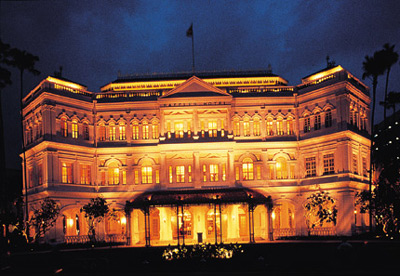
The Raffles Hotel. Home of the Writer's Bar, where
Somerset Maugham and assorted riff-raff used to tip
a few. Birthplace of the Singapore Sling.
The Hindu festival of Thaipusam, where devotees pierce
their flesh and drag chariots through the streets.
Originally published in the Arizona Daily Star, July 18, 2004
