The Getty Center (1200 Getty Center
Drive): Opened in 1997, this dramatic hilltop
campus has quickly become the city’s premiere
museum. The J. Paul Getty Museum collects
and exhibits Greek and Roman antiquities;
European paintings, drawings, manuscripts,
sculpture, decorative arts; and European and
American photographs. It also offers a range of
special exhibitions and educational programs.
Hollywood Boulevard: This mile-long stretch
between Vine and La Brea was the capital of all
things glamorous back in the 1920s but fell on
hard times when the movie studios fled to the
suburbs. Now, thanks to the efforts of the
Hollywood Chamber of Commerce, the area is
making a comeback as a popular and safe
tourist attraction. Highlights include the world
famous Grauman’s Chinese Theater, where
seven generations of movie stars have left their
hands and footprints in cement outside in the
Forecourt of the Stars; the Kodak Theater, now
the permanent home of the Academy Awards;
the Walk of Fame, which has over 2,000 brass
stars embedded in pink and charcoal terrazzo
squares laid into the sidewalks to honor past
and present entertainment personalities; and
world-class shopping and dining at the
Hollywood and Highland Complex.
Eccentrics. The saying is that California is like
a bowl of granola: all fruits and nuts, and the
rest is flakes. Californians would take offense to
this if it weren’t so completely true. This is the
state, after all, that got itself into a US$38 billion
budget deficit a few years after having a
surplus, and then had a recall election with a
slate of over 200 candidates that included a
billboard model, a former child actor, an adult
magazine publisher, and – the winner – an
action movie superstar.
Streets of LA. Los Angeles County has the
largest street system in the US with over 7,700
kilometers of major roads and local streets.
That’s a lot of asphalt! It also has over 1,300
signalized intersections, 9,656 kilometers of
striping, 170,000 traffic signs, 5,000 street
lights, 78,000 street name signs. There are
almost 4,023 kilometers of underground storm
drains, 70,000 street drains, and about 280
sediment entrapment basins. There are over
1,800 bridges and over 145 kilometers of
bicycle trails. The Department of Public Works,
which oversees all the sprawl, is divided into 21
divisions and has over 3,800 employees in
approximately 450 separate job classifications.
Aren’t you glad you don’t do their payroll?
Hooray for Hollywood: Over 609,600 meters
of motion picture film is shot in LA every year.
There are approximately 150 productions being
filmed every day. It is home to roughly 400
sound stages with over 1,350,000 square
meters of space. It has come to mean billions of
US dollars annually for the city. LA is film
friendly, to say the least, and has been since
the early 1900s when the early movie pioneers
packed up their east coast and Chicago based
studios and headed west. LA is a good place to
make movies for a couple of reasons. First is
the wunderbar climate. The fact that it hardly
ever rains means less time lost on expensive
shooting days. The other is location, or, not so
much location as locations, with an “s”. If you
were to plunk yourself down in Hollywood, like
the early mavericks did, you would be 45
minutes from the beach, 45 minutes from the
desert, and 45 minutes from snow-peaked
mountains. Just what you need for your big
budget muscle beach/foreign legion/ski comedy.
Shoppers Paradise: From the 3rd Street
Promenade in Santa Monica to the Galleria in
Glendale, from Rodeo Drive in Beverly Hills to
the Jewelry and Garment Districts downtown, LA
is famous for its shopping. In fact, it is the
largest concentration of retail stores per capita
in the nation and is the second largest market
for international trade, after the New York/New
Jersey area. There are many things to shop for
in a town this size, and many places to buy, so
take your time finding something that fits your
style. Need a kimono? Head on down to Little
Tokyo for a dazzling assortment of colors and
sizes. How about a pair of Italian designer
footwear? Check out the blocks and blocks of
boutique shops on Melrose Avenue between La
Brea and Fairfax. If you can’t find what you’re
looking for in LA, then you can’t get it in the US.
WHY STOP AT 11?
There are so many things to love about LA.
Here are a few more:
Universal Studios. 100 Universal City
Plaza, Studio City. In addition to the famous
“backlot” tour of the old film sets, this attraction
offers several movie themed rides.
Farmer’s Market. 6333 W. 3rd St. Started by
growers during the Great Depression, this
popular spot features foods and entertainment
from around the world.
Griffith Park Observatory. 2800 East
Observatory Rd. This non-profit space
observatory has the sole purpose of providing
the public with information on astronomy and
related sciences.
Disneyland. 1300 South Harbor Blvd.,
Anaheim. What can we say? It’s the happiest
place on Earth.
Sunset Strip. Bursting with great venues that
keep Hollywood busy after dark, like the Viper
Room (8852 Sunset Blvd.) and the House of
Blues (8430 Sunset Blvd.)
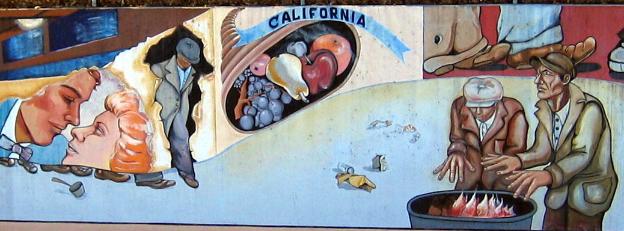
A section of the Great Wall of Los Angeles
(below).
Originally published in Silver Kris magazine, March 2004.
11 Things to Love
about
LA
by Will Kern
Los Angeles is a big city. No, make that a
HUGE city. It is the second largest in the US
with a population of 3.8 million, it encompasses
751 square kilometers, and it is serviced by
five major airports and seven interstate
highways.
It is a major hub of shipping, manufacturing,
industry, and finance. LA’s “Digital Coast”
leads Northern California’s Silicon Valley as a
multimedia center. And of course, LA is a giant
in the entertainment field. If the five-county
Greater Los Angeles area were a separate
country, it would be the 16th largest economy
in the world.
LA is a favorite holiday destination and attracts
millions of tourists o the area each year from all
over the world. It’s also a major gateway to
other states in the US as well as Canada.
There are so many facets to this urban ramble,
so many things the city is known and loved for.
To single out 10 of the best would be a sensible
number, but as California Governor Arnold
Schwarzenegger said last year: “The public
doesn’t care about figures.”
So eleven it is. Of course, it’s hard to know
where to begin, so let’s start at the beach!
Surfing. “Catch a wave and we’re sittin’ on top
of the world.” So sang The Beach Boys in their
1963 classic Catch a Wave that helped
popularize both surf and California culture.
Surfing first came from Hawaii in 1907, imported
by a Hawaiian Irishman named George Freeth
who gave demonstrations twice a day to gaga-
eyed tourists in Redondo Beach, but it didn’t
become world renowned until the 1960s when
The Beach Boys turned out hit after hit about
surfer girls and hot rod cars, and Hollywood put
Annette Funicello and Frankie Avalon in a slew
of popular beach pictures (who could forget the
classic, Beach Blanket Bingo?)
LA is the place to go in the continental US to
catch some waves, catch some rays, or ogle hot
babes in bikinis or muscle bound body builders.
So if you’ve waxed down your surfboard and you
can’t wait for June, put a wet suit on and head to
the ocean! Great surfing can also be found in
the Newport and Huntington Beach areas, an
hour or two south.
Hollywood Bowl (2301 N. Highland
Avenue.): This magnificent entertainment
venue, with its signature arched proscenium, is
one of the largest natural amphitheaters in the
world with a current seating capacity of just
under 18,000.
Many legends have played here: The Beatles,
Sinatra, Streisand, Stravinsky, Pavarotti, Simon
and Garfunkel, Nat King Cole, Abbott and
Costello, Fred Astaire, Garth Brooks, Monty
Python, and on and on. And who can forget
when Bugs Bunny disguised himself as the world
famous conductor Leopold so he could exact
revenge on the bullying tenor Giovanni Jones?
Here’s a fun fact: The all-time attendance record
for the Hollywood Bowl is 26,410 paid
admissions, set on August 7, 1936, for a
performance by teensy French opera star, Lily
Pons.
Phat Food: In the Woody Allen movie Annie
Hall, Allen’s nebbish hero Alvy Singer orders a
plate mashed yeast and bemoans LA’s tasteless
and inferior food, implying that Angelinos have
dormant taste buds and are obsessed sprout
eaters. This could not be further from the truth.
If there is one dish that exemplifies LA more than
any other it is the donut. The donut is the
international dish of LA. There is a donut shop
on every corner in Los Angeles, and if there isn’t
one built there is one under construction.
Angelinos love fat food. Three restaurants that
are definitely worth a taste are:
- Pink’s (709 N. La Brea Avenue): Greasy
cheese burgers, sloppy chili dogs, and
bacon burritos dogs. Diet? What diet?
This place has a line around the building
at all hours of the day, so be prepared to
wait.
- Chicken Delight (6327 Hollywood
Boulevard): Run by a Thai woman named
Jee, this chicken shack serves up the best
fried chicken in LA.
- Canter’s (419 N. Fairfax Avenue): A menu
so big you’ll think you’re in the library.
The corn beef is a smash, but order the
matzo soup, at least. Good for what ails
ya.
Disney Hall (111 S. Grand Avenue): This
89,300-square-meter Concert Hall is something
Walt Disney, the creator of Mickey Mouse and
Donald Duck, might have envisioned. The
exterior features a wavy, steel exterior, designed
to look like a cartoony sailing ship, with its masts
billowing, riding the puffing winds. Internationally
renowned architect Frank Gehry wanted “to
create the feeling of traveling along a
ceremonial barge to music.”
Disney Hall is a three-level complex with a 2,265-
seat auditorium, a grand stairway, an atrium
lobby, a pre-concert foyer, a founders’ room, a
green room, plus several restaurants and bars.
Extensive gardens of flowering trees and plants
surround the building, and it has two outdoor
amphitheaters for musical performances.
The centerpiece of the complex is the Concert
Hall, which is beautifully paneled in Douglas fir
and has soaring glass panels and skylights that
fill the interior spaces with natural light. But can
you hear anything? It was designed to surpass
the best concert halls in the world, and at a cost
of US$274 million, you better be able to hear a
pin drop! Especially now that it’s the permanent
home of the Los Angeles Philharmonic.
The Great Wall of Los Angeles: Considered
to be the longest mural in the world in the world
capital of murals, this ethnic urban canvas is 3.4
meter tall and almost 800 meters long, running
along the Tujunga Wash drainage channel on
Coldwater Canyon Avenue between Burbank
Boulevard and Oxnard Street. It was painted in
the summers from 1975 to 1983 under artist
Judith Baca's direction, using more than 400
youths from around the city, most of who were
delinquents at risk of joining gangs. The mural
is a depiction of California history from
prehistoric times to the 1960s, with dozens of
scenes such as the Spanish conquest, the
roaring '20s, development of the San Fernando
Valley, both World Wars, the zoot suit riots, and
the birth of rock and roll. Most of the Great Wall
of Los Angeles is viewable online at the www.
lamurals.org, along with hundreds of other LA
murals.
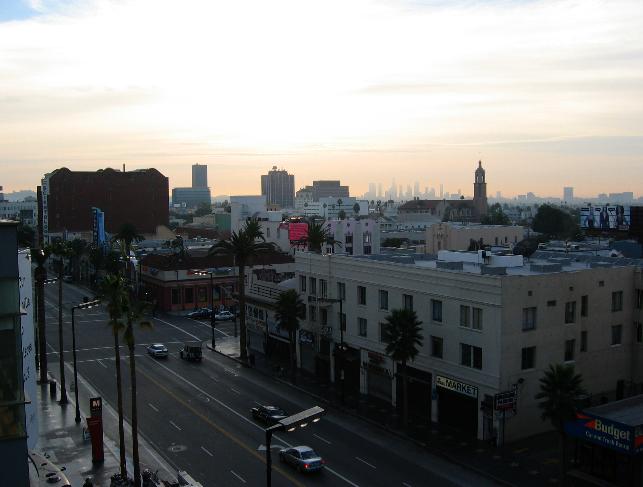
Hollywood Boulevard just after sunrise